February 18
Port Chalmers and Dunedin
With the exception of a few queues at traffic lights, Dunedin is pretty quiet at 08.50. Even the parking meters don’t spring into life until 09.00.
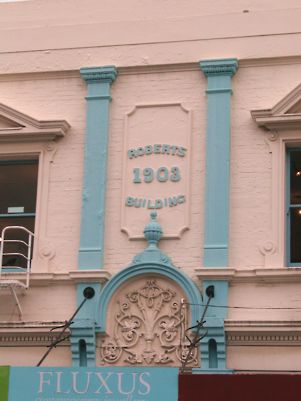 |
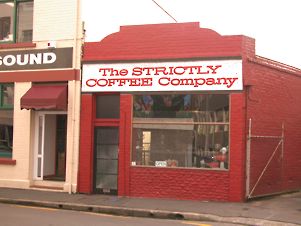
After spotting a few more interesting bits of building, I found a very serious café – The Strictly Coffee Co – for the first hit of the day. With full ceremony, I was given a half cup of lethal coffee, a small jug of hot water and a glass of cold water. This is definitely the real thing. |
 |
|
|
|
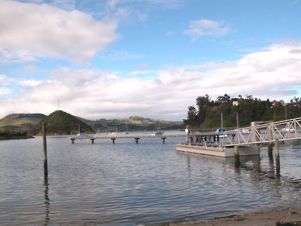
Port Chalmers is about 10k down the harbour and is the main deep water port of Otago. It was founded as the original Scottish Presbyterian settlement in these parts. The road and railway follow each other there around the bays, occasionally diverging when the railway takes a short cut across the water or dives into a tunnel.
 |
 |
|
|
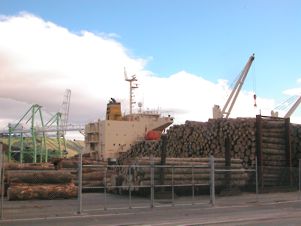
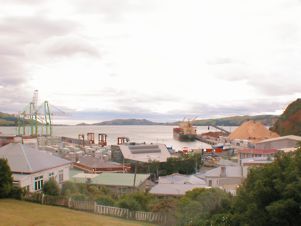
The town has two faces, an old settlement with a pretty marina and a bustling industrial port. The port has a huge wall of logs, some of which are currently being loaded onto a ship.
|
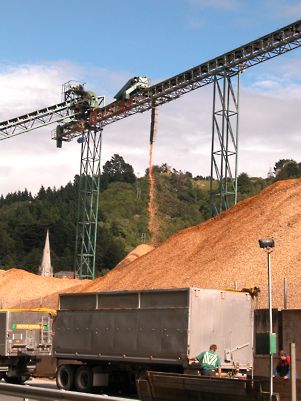
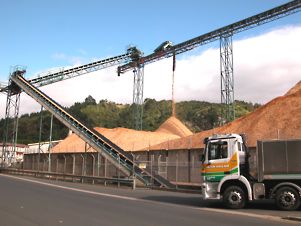
It also has a literal mountain of woodchips. The trucks queue up to drop these into a pit from whence a huge conveyor system transports them upwards and upwards until they are finally discharged onto the top of the mountain. Diligent observation indicated that the complete journey from bottom to top takes 36 seconds. |
 |
 |
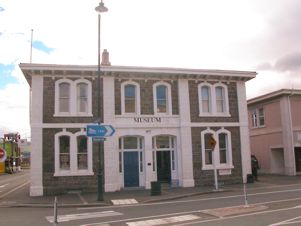
The museum occupies the old post office building and is a fairly normal collection of stuff with, naturally enough, an emphasis on matters nautical. Two items took my eye – and they were at different ends of the spectrum of life.
The Port Chalmers Harmonica Band lasted from 1937 to 1967, during which time it won countless awards. There was a lovely collection of trophies, photographs and harmonicas.
 |
“Blackbirding” was a much more sinister practice, being the local equivalent of the slave trade. In the 1860’s, boats raided some of the Pacific Islands, with Niue and Tokelau being particularly hard hit, seized whole populations and carried them off to work as slaves in the phosphate mines in Peru. The islanders proved to be poor slaves and a general outcry brought an end to the process, with some of the slaves eventually being repatriated. The exhibit records that of the 3634 who were seized, 257 survived but only 164 ever returned home. They took with them diseases previously unknown to the islands, which thus underwent a further depopulation as thousands died. |
Port Chalmers Museum |
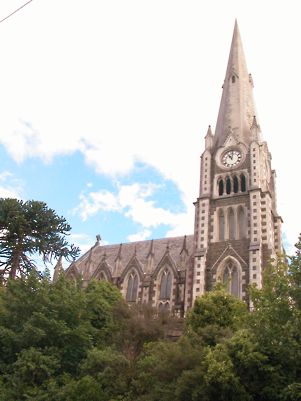
There are still some fine buildings in the town, notably the Iona Presbyterian Church, an excellent example of local gothic. Unfortunately, it was locked so that I couldn’t enter but the terrace which surrounds it proved a good location from which to take photographs of the port.
 |
 |
|
|
 |
 |
|
|
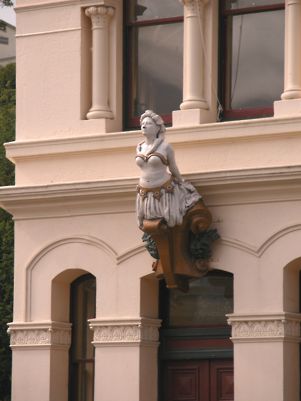
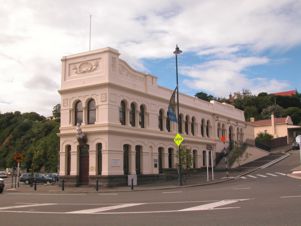
The old town hall and BNZ bank buildings are also fine, each sporting a nautical style figurehead. The pubs are tatty but numerous. Much of the rest of the town is just tatty. I was told that it was on the up but I saw few signs - just one trendy looking antiques and coffee shop.
On the opposite side of Dunedin is St Clair, beach resort and home to the surfies. Having visited it in the dark last night, I decided to see it in the daylight. The promenade has recently been re-built, although I am told that the first major storm after it was opened knocked large lumps off it.
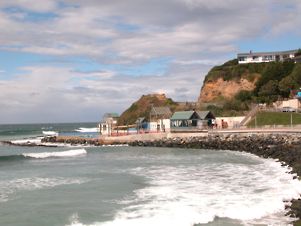 |
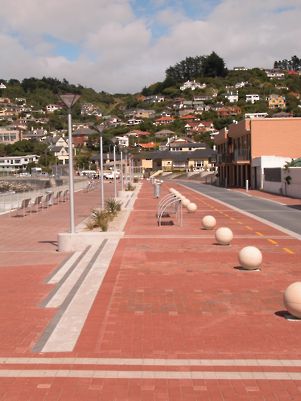
Above: St Clair promenadeLeft: The Hydro, St Clair |
|
|
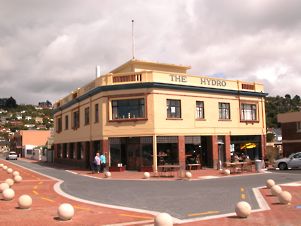 |
The pub where we went last night is a nice enough old building and serves good food. It also has a blazing log fire which, to my mind, was a trifle excessive on a warm day. It got busier and busier, with large parties arriving so, in the end, I wolfed down my Caesar salad and left.
Once back in the city, I stopped near the Exchange, the old financial centre, took the obligatory architectural shots and examined the menu at the brewery, where we were booked in to eat in the evening.
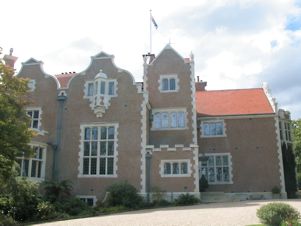
Olveston was built between 1904 and 1906 and designed by Sir Ernst George, a London architect. David Theoman, originally from near Bristol, raised his family there and his daughter lived there until her death in 1966. She bequeathed it to the City of Dunedin to be used as a museum and it has been open to the public ever since. It is excellent but it was far too busy. As well as the scheduled guided tour of which I was a participant, there were a couple of coach parties touring the house.Right: Olveston |
 |
We kept bumping into each other in the narrow corridors and much of the pleasure of the tour was lost. The house contains some paintings and some furniture to die for – but I think my silver is better!
In the evening, we returned to the Brewery for a large and acceptable quality meal.
| Next Day |