February 29
Darwin
I had been outside the hotel for a couple of minutes when the coach arrived seven minutes early. We cruised the city in a huge modern coach, collecting people as we went. Most of them seemed older than me so I ought to be able to survive the rigours of the day.
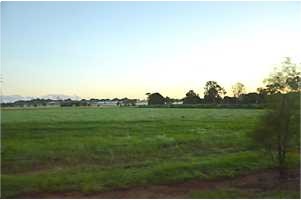
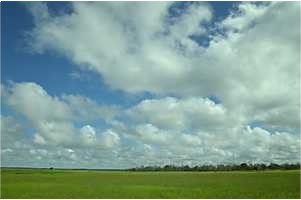
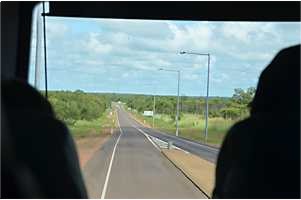
Rob, the driver, cracked all the usual jokes but seemed calm and measured in everything he did. We drove fast along tree-lined highways, passing through lots of small settlements. Photography was very difficult & the results poor.
 |
 |
|
|
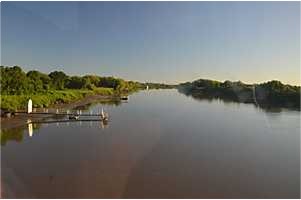
One of the more unusual sites was the large numbers of mango orchards that we passed. Ditto the termite mounds, although I was to see many of these from the train. There were also lots of wallabies. Very delicate little animals. They all managed not to run (hop?) across the road in front of us but Rob said that it did happen from time to time. We also crossed some very large rivers.
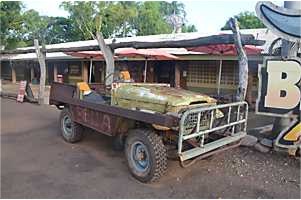
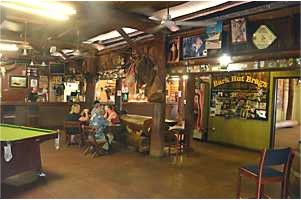
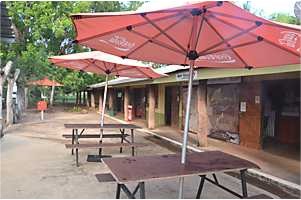
A couple of hours after leaving the hotel we stopped at the Bark Hut Inn, an olde worlde Northern Territory pub and coach stop.
Given the length of time since we left the hotel, I was very grateful that I had the foresight to make filled rolls last night. Without them, I would probably have expired long since. The pub had an assortment of historic artefacts and also a pair of buffalo, Jack and Jill, hiding in the sun so no photographs, and some emu. The coffee wasn't up to New Zealand standards but it was drinkable. After my packed breakfast, I didn't feel the need to sample the toasted sandwiches, which didn't look exciting. |
 |
|
|
 |
 |
|
|
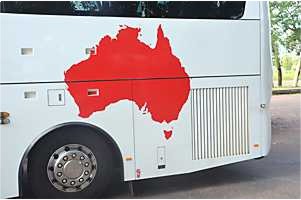
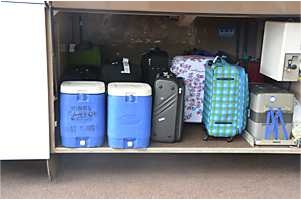
AAT Kings, the coach company, have the motto of bringing Australia and New Zealand to life. I pointed out to Rob that whilst there was a lovely map of Australia on the side of the coach, where New Zealand should have been was a radiator grille. I don't think he took my complaint seriously. Can't think why. It did have a boot full of chilled water, which was to prove very useful.
 |
 |
|
|
Rob gave us our National Park passes. These included a "Welcome to Land"
statement.
"The Aboriginal traditional owners welcome you to Kakadu National
Park. We are happy and proud to share this special place with you. We hope
you take the time to look, listen and feel the country, to experience the
true essence of this land. Take care and return safely to your family and
friends and share the memories and stories you will learn from our country."
In days of yore, the tribal elders used to do this in person to all visitors. Now that there are too many people to do this, they put it in writing. Rob gave us a very long talk on the park, its history, its people and its wildlife. All the guides including, it would seem the coach drivers, have to be trained in all aspects of the park and there seemed no doubt that Rob was both knowledgeable and enthusiastic about the park and its people.
He gave us far more information that I could absorb. There had been attempts to introduce buffalo and pigs, both of which had been both commercial and environmental disasters. Farming hadn't worked and, in the end, the National Park had been established in 1979. It is half the size of Switzerland (the same size as Slovenia, 20,000 k2).
Until the 1960s, Aboriginals were classified as flora and fauna and had no rights to do anything. Big Bill Neidjie was largely responsible for having an aboriginal claim to Kakadu recognised and then negotiating the arrangement whereby the national park was managed as a wild area to be shared as a resource for all Australians.
Mineral rights continued to be a bone of contention and there was a danger of the mining companies destroying the environment. Even now, the National Park encircles the world's largest uranium mine, The Ranger, although this is now being run down and is only processing stockpiles of mined ore.
The various inquiries, notably the Fox Inquiry in the 1970s, recognised that the area has the longest continuous occupation of any area in the world, over 40,000 years. It also has a huge collection of rock art and there are three main language groups. This is all I can remember but we were told far more than that.
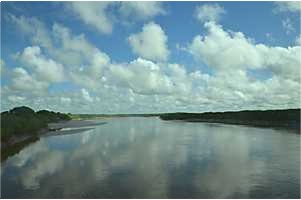
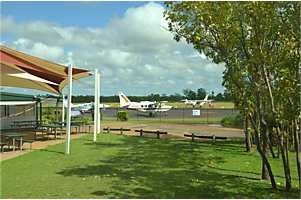
Just to cheer us all up, we were told that dehydration kills far more people than snakes, crocodiles and spiders combined. All of the animals were potentially dangerous and best photographed from a distance of about one kilometre! The crocodiles were extremely dangerous both in and near water.We crossed the South Alligator River - not many alligators but lots of crocodiles - and stopped briefly at Jabiru Airport, to unload a couple who were taking advantage of the opportunity to fly over the park. |
 |
|
|
 |
 |
|
|
 |
 |
|
|
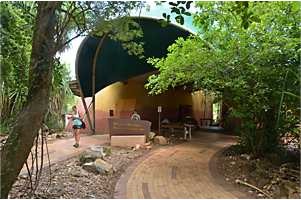
We then drove on to the Warradjan Aboriginal Cultural Centre. Photography wasn't permitted here so I can only illustrate the front entrance and can't remember too much about what I saw. It was interesting but didn't contain much that couldn't be found in the aboriginal collections in most of the main museums in Australia. The lady in charge was blonde and pale skinned - ie just as much an indigenous Australian as I am.
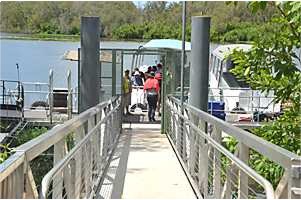
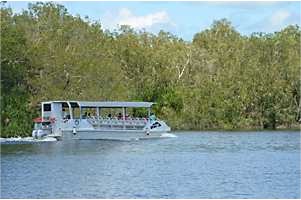
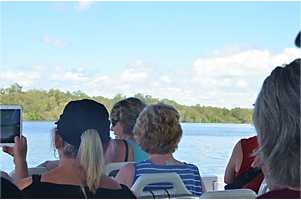
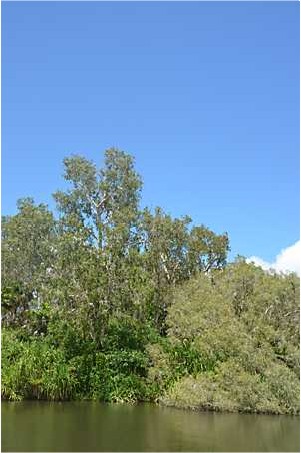
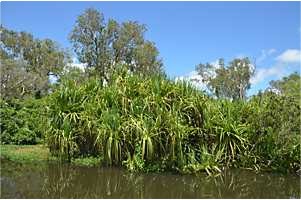
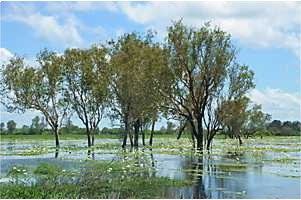
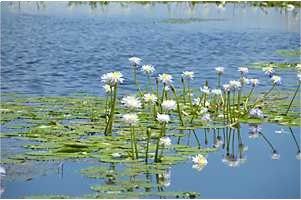
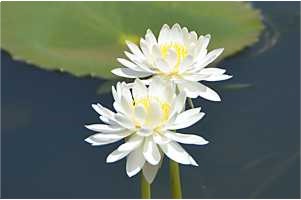
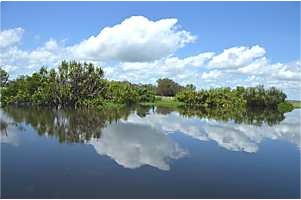
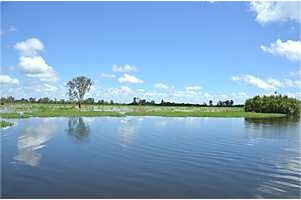
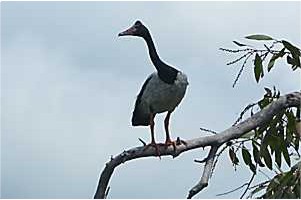
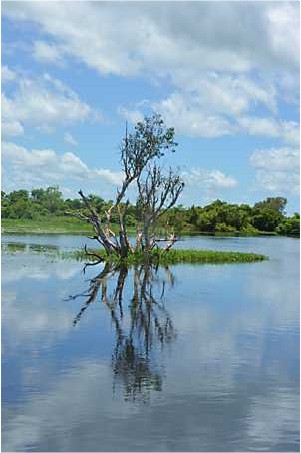
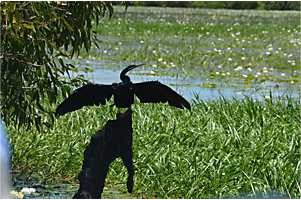
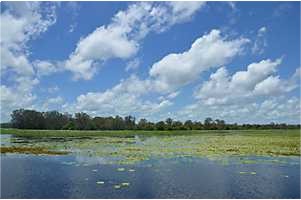
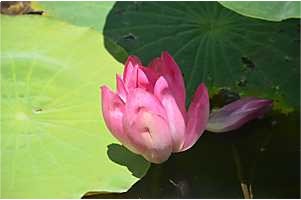
After about another quarter of an hour, we parked up and walked down a short path to a boat on the waterway. We climbed aboard and began an hour and a half of wonderment on the Yellow Water Billabong Cruise. The photographs will have to do most of the talking.We navigated our way along rivers and through swamps and billabongs (lakes closed off by changes of river flow), observing flora and fauna as we passed. The flowers were spectacular, with white lilies carpeting the water. |
 |
|
|
 |
 |
|
|
 |
 |
|
|
 |
|
|
|
 |
 |
|
|
 |
 |
|
|
The clouds had an amazingly fluffy consistency and created wonderful reflections in the water.
 |
 |
|
|
 |
|
|
|
 |
 |
|
|
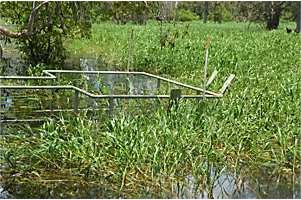
The changes in water level, depending on the season, were illustrated by the disused gangways and landing platforms which could be seen. These will come back into use at other times of the year.
Right: Not to be used until the tide goes out! |
 |
We did see a crocodile - all I actually saw was the back end of a very small crocodile but I think some of the others saw a bit more of it.
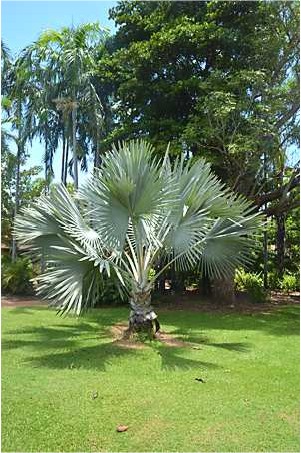
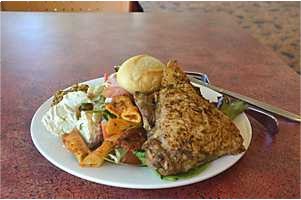
By almost 1.30, lunch called and we disembarked and had another short drive to one of the hotels for a buffet lunch.The food was plentiful and not at all bad. The air conditioning was welcome after the heat and humidity outside. |
 |
 |
|
|
|
From there, it was a 40 minute drive to our next port of call, the rock art at Anbangbang. The precise name of the area varies according to which of the local languages is used.
The art is in an area traditionally associated with the Warramal Clan, which has now died out so a neighbouring clan has taken over responsibility for the art. This complex set of relationships was quite beyond me.
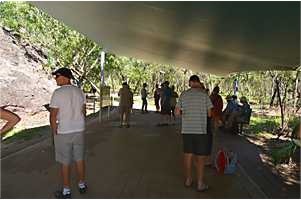
We started at a sheltered area with lots of information boards in 38 degree heat.
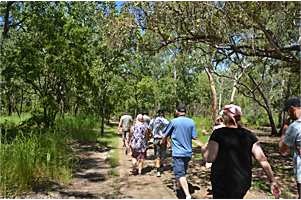
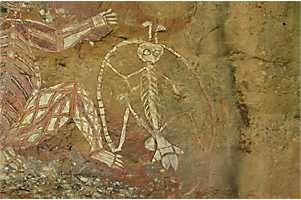
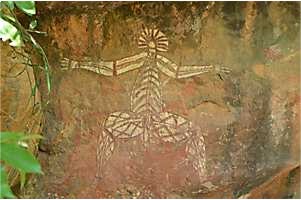
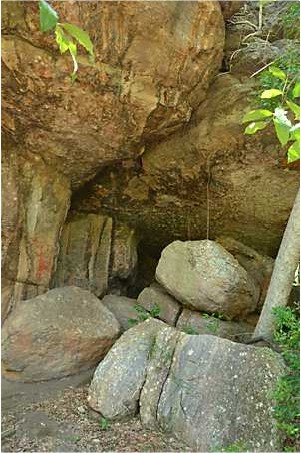
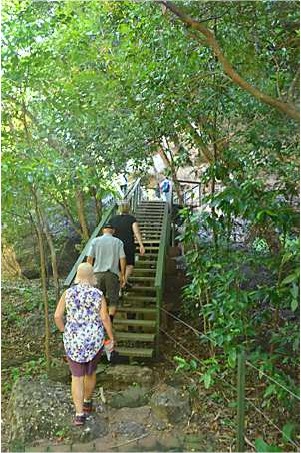
A lightly wooded area took us to the foot of the cliffs, where we found some striking images on the sandstone cliffs. We climbed up some steps and reasonably rocky slopes to more and then more paintings. The going was reasonably rough but, had it not been for the heat, it wouldn't have been too difficult.
 |
 |
|
|
 |
 |
|
|
 |
 |
|
|
 |
 |
|
|
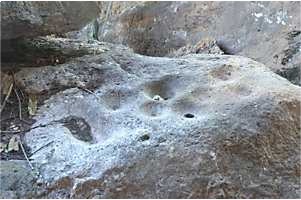
As it was, it was tiring, particularly in mid afternoon after an early start. One of the rocks had many small indentations in it after lengthy use as a site for mixing pigments.
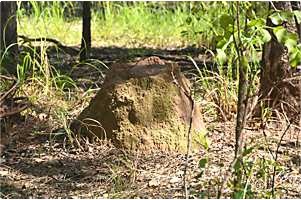
By the bus were several termite mounds of the sort that were to be very common as soon as I boarded the train. After nearly an hour, we returned to the bus and drove a short distance to the Crocodile Hotel at Jabiru, where we dropped off many of the party. The building is of corrugated iron, or similar, and built in the shape of a crocodile. For some reason, I failed to take any photographs.
A few kilometres further on, we dropped off more, including the driver, at another hotel. They were spending the night in the park and returning after another day in a smaller vehicle. In retrospect, had I planned the trip with greater knowledge, I would have done the two day trip. Travelling that distance for a day trip didn't really make sense and there is so much to see out there. The 20 seat 4WD vehicle had been driven out from Darwin to meet us so we changed drivers, with Rob staying and the new one, who's name I have forgotten, taking us on the two and a half hour trip back to Darwin. This was all very smooth, with nine of us making the journey.
The roads were incredibly quiet until we reached the outskirts of the city. I had to complain to the driver that we arrived back at the hotel one minute early. Not bad after a trip of about 200 kilometres!
 |
 |
|
|
 |
|
|
|
|
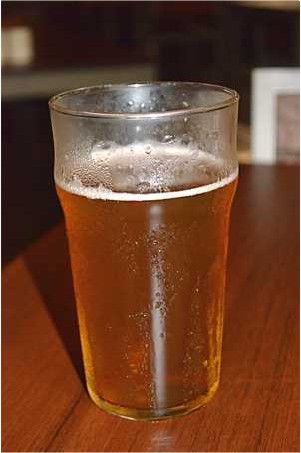
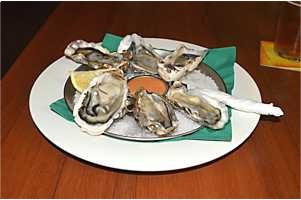
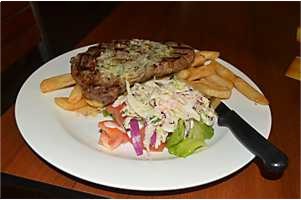
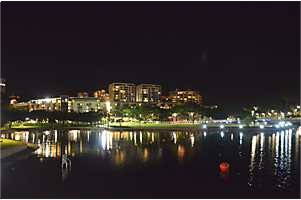
I dumped some of my belongings in my room and, at 7.30, set out in search of dinner. The Irish pub, where I had breakfasted the day before, gave me a couple of cold beers - not local as they are hard to find - half a dozen oysters and a perfectly cooked rare steak. I had several steaks on this trip and only a couple of them were actually rare. The others were medium at best. A very good dinner. I had a quick walk around the area and returned home to bed. |
 |
|