March 1 to 8
Port Fairy to Oblivion
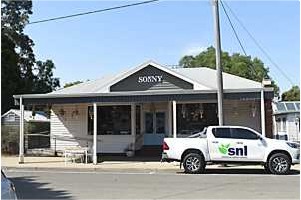
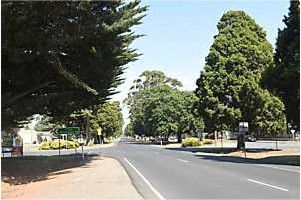
I left Port Fairy at 08.00, partly to make sure I didn't have to rush and partly to do at least part of the journey in the cooler weather. This worked to an extent as it was about 20 degrees when I left but approaching 30 when I reached Mortlake for a coffee stop just after an hour later. As I was driving, I couldn't take photos of the drive but the road wasn't particularly exciting. Mortlake wasn't particularly photogenic, either, but I did need a rest.
The first major photographic error of the trip. I forgot to check the camera settings this morning so that the few pictures I took before 11.00 were completely over exposed. It's just as well that I didn't see anything particularly interesting. Most of the photos that I had taken were intended to show that the area wasn't very exciting.
I discovered the problem at Inverleigh, where I made my second stop. It seemed the obvious place for elevenses/lunch, with slightly less than 50 kilometres to go, after which I would be straight onto the train into Melbourne.
 |
 |
|
|
I had a cold and almost sugar free drink with a chicken foccacia. This turned out to be rather filling - or so I thought at the time - so I wrapped half of it in a napkin and took it away with me for later.
The world came to an end rather rapidly and rather surprisingly after this. I left the café, not feeling 100% and with half of my sandwich uneaten. Both of my elbows hurt, with nerve type pains, and my chest felt very slightly congested. In spite of this, I was brave and continued driving along reasonably quiet roads for about 40 minutes. I left the B road and then followed the motorway briefly, before branching off onto the A road into Geelong. I was very hot, very tired and in some pain. In spite of all this, I arrived at the Avis office without putting a foot wrong. I handed the car back to the same lady who had given it to me and I asked her to summon me a taxi.
It was baking hot outside but the office was cool enough. I felt seriously seedy. The taxi took me to the station, a ten minute journey, by which time I was feeling very hot and my arms hurt an increasing amount.
I managed to carry my bags over the bridge to the opposite platform and waited five minutes for the train to arrive. By now, I was exhausted, soaked in sweat and in a reasonable amount of pain. As the train drew in, I felt nauseous but decided to board it anyway and hope for the best.
The one hour trip actually took 70 minutes because the heat had expanded the tracks. Just like in the UK but you would think that the Australians would be better accustomed to it. At Southern Cross Station, I managed to leave the train and staggered the length of the platform. It was a struggle.
I found a couple of uniformed railway men and begged them for help. They said that there wasn't a first aid post at the station but they could call an ambulance. We agreed that I didn't look that bad, I was still talking lucidly and I could still walk. They handed me over to a couple of the station security men who also considered summoning an ambulance. In the end, they found me a taxi, which took me about 400 metres up Collins Street to the hotel, where I managed to check in.
I made it upstairs (via the lift) to my room, where I had a shower, took some paracetemol and lay down.
Four hours of this achieved nothing and I still felt horrible. I did decide to pop out and visit the dairy a few doors down the street to buy some food. This mission accomplished, I tried to sleep it off for another couple of hours.
By 20.00 it was dawning on me that there must be something seriously wrong so I stuffed some important documents, money etc etc into my camera bag, returned to the reception area and asked the young lady at the desk if she could summon an ambulance for me. I waited outside the hotel, watched as the lights rushed up Collins Street and, with a wait of barely five minutes, I was inside having questions fired at me by the paramedics. They also started to extract blood samples, non-too gently, and told me fairly rapidly that I was having a heart attack.
Within a few minutes, the ambulance was being reversed into the loading bay of St Vincent's Hospital, from where the lift rushed me and my stretcher into the cardiac unit. By now, I was stuffed full of drugs and barely aware of what was going on.
For the next six days, life became somewhat surreal. A couple of hours after arriving, I was wheeled upstairs and into Ward 4 West of the Cardio Thoracic Care Centre, where I was put into an intensive care bed and plugged into all manner of machines and drips. I was not to emerge from the ward for almost a week.
I was subjected to constant testing of my blood, my blood pressure, my weight, my temperature, my pulse rate and, doubtless, numerous other things that I didn't know about.
The staff were amazing. Caring, organised, friendly etc etc. There must have been moments of chaos but they weren't apparent to the patients. The man who sorted my artery on the first night, one of the top men in the field I was told, looked a real hard case with jeans, boots and stubble - I assume he changed before he started operating! His work was successful, however, so who cares!
Life was a constant series of tests and pill taking sessions. Everything was dutifully logged and checked and I couldn't possibly count the number of times that I recited my name and date of birth.
Members of the admin staff helped with the conversion of documents, photocopying etc etc of material that I needed to send to the airline, the insurance company and so on. How I would have handled the logistics of the process without their help and without the WWW, I do not know.
I had visits from two lots of medical students. Firstly, two nineteen year old girls, who "interviewed" and examined me for an hour. Of wildly differing appearances and personalities, they made a good team and should both go far. On the penultimate day, an older boy, looking completely terrified, was sent in to extract a blood sample from me. As my arm now looked like a WWI battlefield, this was no easy task. He did well, however, and I was careful to congratulate him. He still looked terrified!
The pastoral care lady stopped by for a chat. It transpired that her daughter and one of the nurses had been best friends at primary school.
All good things must come to an end and after four days I was moved from my private room into a shared one. This was incredibly noisy, meaning that I had minimal sleep for the last two nights. The constant series of overnight blood tests continued so that the noise probably didn't make too much difference. By my last morning there, I felt terrible but this was more to do with lack of sleep than with my heart or all of the drugs.
By mid morning, the room was clearing and I was packing in preparation for my departure. I was signed off, issued with discharge papers and sent downstairs with my bags to await the pharmacist. This took an hour. When she finally arrived, she was most apologetic and issued me with a huge bag of drugs. Organising them will be an interesting problem.
The lady in charge of the discharge room found me a taxi and my time in hospital was over. It was interesting, to put it mildly, and it is to be hoped that the treatment that they gave me was successful. It did, however, completely remove my desire to document the remainder of my trip.